When Saturn Ascends

In Roman mythology, Saturn was the god of agriculture and time. It reminded them that nothing worthwhile could be harvested without patience. For the Greeks, he became Chronos, the devourer of his own children, the planet that consumes its creation. The medieval alchemists associated Saturn with lead, the densest and the slowest of metals, and the first stage of transformation, where every illusion must decay before anything noble can emerge. In our life, there comes a time when Saturn ascends, and I do not mean this astrologically, although astrology has long recognized Saturn as the great examiner. I want to talk about something beyond that.
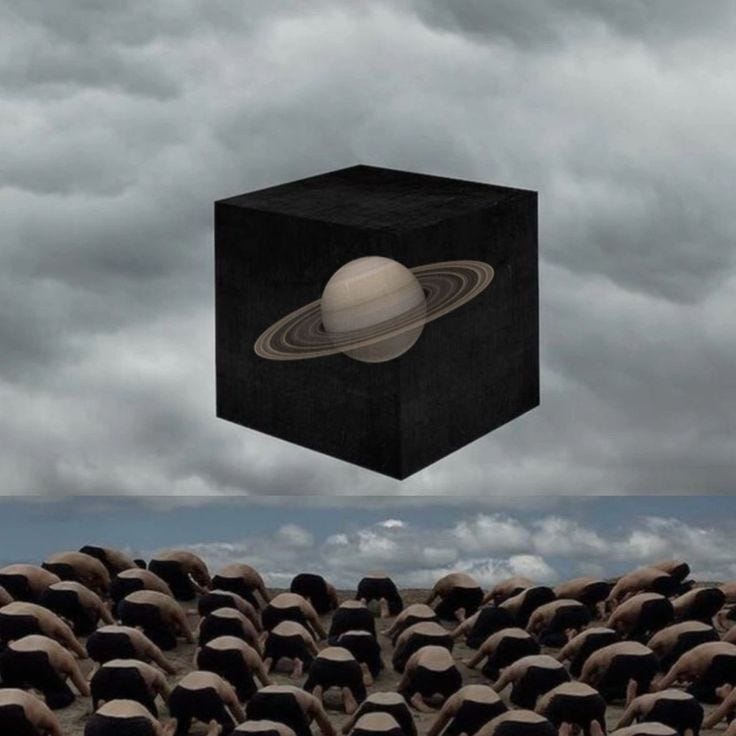
If we study ancient texts, Saturn can be almost understood as an archetype. The archetype gives us the inexorable realization that everything is finite. Saturn arrives quietly. There is no loud thunder. It is just decay. It can be as simple as a parent's hair turning grey. One of your friends now has children. A familiar street has now disappeared beneath new concrete, and suddenly, one morning, you discover that your body remembers injuries it once ignored. Another morning, you realize there are more years behind your parents than ahead of them. Saturn does not announce itself. It accumulates, and then one ordinary afternoon, Saturn ascends.
It asks, what have you become? That question possesses a peculiar violence because it strips away the illusion of neutrality. Under Saturn's gaze, direction becomes unmistakable. Consciousness either sublimates itself into something nobler or it relinquishes itself to appetite, distraction, resentment, or inertia.
We have forgotten that freedom also possesses a vertical dimension. We speak incessantly of freedom, but we always do that in a horizontal term. The more choices we can have, the more wealth we can accumulate, the more identities we can have, and the more lives to sample before death interrupts that experiment.
But Saturn is indifferent to multiplicity. Saturn concerns itself only with the altitude. How high did your consciousness rise while it briefly inhabited flesh?
This is why this line always haunts me with its unbearable honesty:
"Repugnant is the creature who will squander its ability to lift an eye to heaven, conscious of its fleeting time here."
The line does not dwell on cruelty or violence. It dwells on squander. The lyric presupposes something terrifying: that consciousness is not merely a biological accident, but it is an inheritance, that to be awakened into existence is to receive an impossible privilege, the capacity to apprehend beauty, truth, transcendence, mortality, and infinity, all while knowing that the interval allotted to us is heartbreakingly brief.
We inherited a nervous system capable of contemplating the architecture of galaxies, but instead we devote them to trivial resentments, algorithmic compulsions, and the ceaseless liturgy of distractions. Throughout history, never has a civilization possessed greater access to philosophy, literature, art, science, and history than it does right now, and at the same time, never has a civilization become so proficient at anesthetizing its own awareness.
We are here for a brief time. Our bodies will eventually fail. All the reputation that we ever gained will dissolve, and our memories will fade away. What remains is the quality of the consciousness that inhabited those passing years.
The greatest tragedy of humanity is that it is capable of transcendence, yet so frequently it settles for triviality.
There exists a hierarchy of being. At its lowest level lies mere appetite, to consume without any contemplation, to receive pleasure without any gratitude, to be in a survival mode without any wonder. There is nothing shameful about these impulses. Every living organism depends upon them. But if our existence never rises beyond them, then consciousness is served only to refine instinct.
A wolf can hunt because hunger compels it, but a human being can choose to fast. An animal needs to defend its territory because nature demands that, but a human being can learn to forgive. An animal lives with necessity, but the human being was entrusted with the terrifying possibility of transcendence.
And perhaps this is what differentiates us from animals, the ability to orientate ourself towards something higher. We can either look down towards possession, distractions, and immediate gratification, or we can look upward towards aesthetics, growth, sacrifice, wisdom, and creation. Neither direction will abolish suffering. Both remain equally mortal. But the thing is, one enlarges your soul while the other gradually contracts it.
Saturn will eventually demand an accounting. One day he will ask, what did you become? What shape did your consciousness assume while it briefly occupied flesh? On that day, every distraction will lose its authority, and every performance will become transparent. Every excuse will seem unbearably small, and only one question will remain. Having inherited the impossible privilege of consciousness, how hi
gh did you allow it to rise?
Some paragraphs are actually tooo good. I read them twice or thrice .